Scaling UX and Product Delivery with AI
Overview
At Treasury4, I began integrating AI into my workflow to address a growing challenge: maintaining high-quality product delivery while absorbing expanding responsibilities across UX design, product ownership, and research.
Over a 90-day period, I used AI as a structured collaborator to support requirements documentation, UX analysis, backlog management, and domain research. By building repeatable workflows and prompt structures, I was able to increase delivery speed while improving consistency and clarity across product artifacts.
The result was measurable gains in team throughput, stronger documentation for developers, QA, and customer success and the ability to support product management responsibilities without additional headcount.
Human–AI Collaboration
Used AI as a structured collaborator while maintaining product judgment, validation, and stakeholder alignment.AI-Assisted Product Documentation
Scaled the creation of Jira stories, acceptance criteria, and technical specifications for both human developers and AI-assisted coding tools.AI for Product Research
Accelerated domain research and competitive analysis to inform product decisions.Process Innovation
Developed reusable workflows that increased output while maintaining quality and clarity across teams.
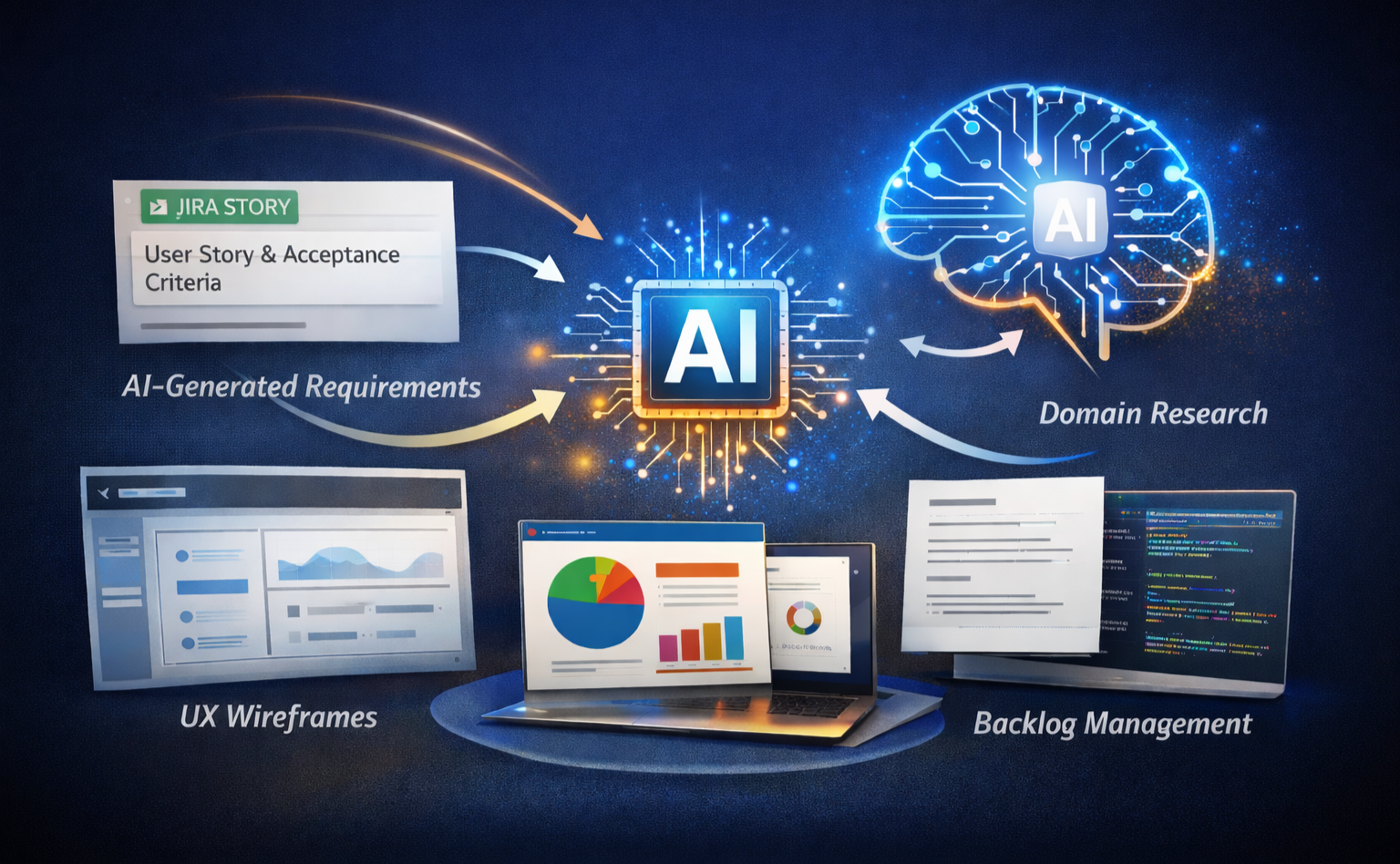
Image created by Chat GPT based on this article
Impact
40+ Jira stories created or improved
8+ UX deliverables produced
5 executive/customer presentations created
Story writing time reduced from 1–2 hours → 15–30 minutes
Product Context
Treasury4 is a multi-module enterprise treasury management platform used by financial teams to manage cash, payments, debt, and foreign exchange.
During an organizational transition, I took on significant product ownership responsibilities alongside my UX leadership role. This meant writing detailed requirements, managing backlog priorities, designing UX solutions, and researching complex financial workflows.
To keep delivery moving at the pace our development team required, I began integrating AI into my daily workflow as a design and product partner.
The Challenge
Our developers relied heavily on well-structured Jira stories to build features efficiently.
Poorly scoped stories often caused:
Delayed development cycles
Repeated clarification conversations
Inconsistent requirements quality
At the same time, I was operating as:
The primary UX designer
The acting product owner
The feature research lead
I needed a way to increase output without sacrificing quality.
My Approach
Rather than using AI for occasional tasks, I integrated it across the entire product workflow.
AI supported four core areas of my work:
Requirements documentation and backlog management
UX analysis and wireframing
Customer-facing content creation
Domain and industry research
The key was creating repeatable prompt structures and workflows, allowing AI to function as a reliable collaborator instead of a one-off tool.
Use Case 1: Scaling Jira Story Creation
Problem
Developers required detailed stories containing:
Acceptance criteria
Edge cases
Technical notes
QA guidance
Writing these manually could take 1–2 hours per story.
Solution
AI helped convert rough notes, meeting discussions, and product ideas into structured Jira stories.
These stories included:
Standardized user story format
Acceptance criteria
Testing instructions
Cross-references to related features
Impact
Story creation time dropped to 15–30 minutes, while improving clarity for both developers and QA.
Use Case 2: Faster UX Analysis & Planning
Problem
Complex backend features required UX translation before developers could build them.
Producing wireframes and interaction patterns normally required multiple design cycles.
Solution
AI assisted with:
Reviewing feature requirements
Identifying interaction patterns
Generating annotated planning wireframes
These planning artifacts helped developers understand intended behaviors before implementation.
Impact
Wireframes that previously required multiple design sessions could be produced in a single working session.
Use Case 3: Customer-Facing Content
Problem
Customer Success and Sales teams needed regular updates explaining new features.
Manually analyzing large Jira exports was time-consuming.
Solution
AI analyzed Jira data and helped generate:
Release summaries
Customer presentations
Product roadmap visuals
Impact
Executive-ready summaries could be produced within hours of receiving feature data.
Use Case 4: Domain Research
Treasury software requires knowledge of banking standards and financial concepts.
AI helped accelerate research into topics like:
ISO 20022 payment standards
banking structures
corporate governance documents
This allowed requirements and UX decisions to be made faster while still validating final details with domain experts.
Workflow Innovation
One of the most valuable outcomes of this work was creating a Jira Story Creation template. A structured prompt designed to standardize story quality.
The template evolved based on developer feedback and includes:
Clear story formatting
Acceptance criteria guidance
QA testing instructions
Structure usable by both human developers and AI coding agents
This became a repeatable process artifact used across the team.
Results
Over a 90-day period, AI became an integrated part of how I work as both a UX leader and product owner.
The biggest impact was not just speed, but consistency and scalability.
AI enabled me to:
Support development with better documentation
Accelerate UX planning
Deliver executive communication faster
Absorb product responsibilities without additional headcount
AI didn’t replace design judgment or stakeholder collaboration, it compressed the time between idea and artifact.
What This Demonstrates
This work demonstrates how designers can expand their impact beyond traditional UX deliverables by integrating AI into product workflows.
Rather than using AI as a standalone tool, I focused on building repeatable systems that support the entire product lifecycle, from research and requirements to design and communication.
Key capabilities demonstrated in this project include:
AI-Augmented Product Workflows
Designing processes where AI supports requirements writing, UX planning, and research while maintaining human oversight and product judgment.Bridging UX and Product Management
Operating across design and product responsibilities by translating stakeholder needs into structured specifications developers can act on.Designing for AI Collaboration
Creating prompt structures, templates, and documentation formats that enable AI tools to produce consistent, high-quality outputs.Scaling Individual Impact
Using AI to increase delivery capacity while maintaining clarity, quality, and alignment across teams.
This project reflects an emerging model for modern product design, where designers not only create interfaces, but also design the systems and workflows that enable teams to build better products faster.